
 By
By 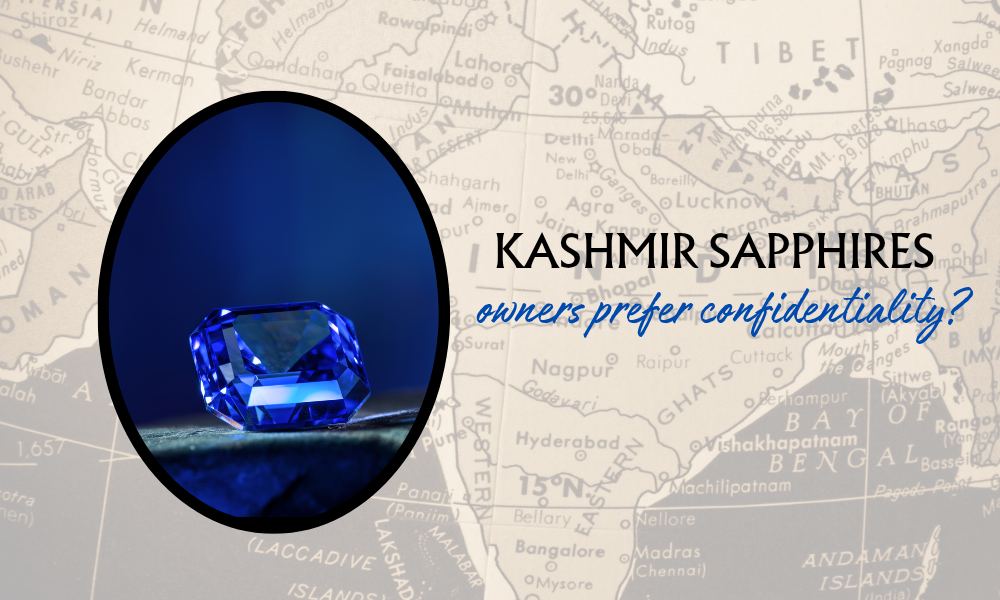
Kashmir sapphires occupy a rarefied place in the world of colored gemstones. Originating from a high, remote region in the Zanskar Range of the Himalayas, these sapphires were first discovered in the early 1880s after a landslide exposed rich sapphire-bearing rock. The stones quickly became known for their deeply saturated “cornflower” or velvety blue hue, due to microscopic silk inclusions that diffuse light in a uniquely soft way.
The mines were active for only a short period, from roughly 1882 to 1887, and while sporadic mining continued into the early 20th century, the most exceptional Kashmir sapphires came from this brief “Golden Age.” The original deposit was largely exhausted by the late 1880s, and although later workings extended sporadically until the 1920s and 1930s, nothing matched the brilliance and caliber of the early finds.
THE SPIRIT OF KASHMIR
The Spirit of Kashmir sapphire stands today as perhaps the most publicly recognized Kashmiri gem because it holds a Guinness World Record. The gem weighs 150.13 carats and has its origin in Kashmir (India). The big Kashmir sapphire is cushion-shaped. It was Goldiama LLC in Dubai, that had the Spirit Of Kashmir, submitted for a Guinness World Records listing.
This remarkable sapphire exhibits the true characteristics collectors’ revere. Its size is extraordinary and the gem has become a benchmark for the rarity and prestige of Kashmir sapphires.
The recognition of the Spirit of Kashmir by a global institution like the Guinness Book of World Records serves both as a testament to its significance and a public rallying point for how extraordinary Kashmir sapphires are. Yet it also highlights a subtle tension in the gemstone world: many private collectors or owners of high-value gems often avoid such publicity because public records can draw tax scrutiny, insurance interest, or unwanted attention that could affect the gem’s privacy or perceived value.
THE ZANSKAR CROWN SAPPHIRE
While the Spirit of Kashmir is well documented and public, the Zanskar Crown Sapphire remains shrouded in lore, fragmentary information, and ongoing speculation.
Origins and Early Ownership
The origins of the Zanskar Crown trace back to the Kashmir royal treasury in the late 19th century. According to details available so far, a massive piece of rough Kashmir blue sapphire, rumored to weigh around 500 carats, entered the treasury during the reign of Maharaja Ranbir Singh (1857–1885). The stone was apparently cut and polished into a large cushion-shaped gem (170-220 carats), after which it gained the informal moniker “Zanskar Crown.”
Maharaja Pratap Singh, who succeeded Ranbir Singh, ruled Jammu and Kashmir from 12 September 1885 to 23 September 1925. He was a pivotal figure in the region’s modern history, navigating complex political pressures under British colonial influence as well as internal development aspirations.
Pratap Singh is believed to have showcased the Zanskar Crown in an exorbitant necklace or ceremonial ornament, possibly to display the region’s wealth and prestige. However, there’s no strong evidence that it was ever set into an actual crown — a detail that may be more myth than fact, since Maharajas traditionally wore turban ornaments, not crowns.
Facing financial strain in the early 1920s, Pratap Singh reportedly decided to sell the Zanskar Crown to fund public works and his developmental vision for Kashmir. The gem, along with other treasury jewels, is thought to have left for Europe with a private collector, but reliable documentation of its subsequent ownership history is limited.
If these size details proved to be accurate, the Zanskar Crown would surpass the Spirit of Kashmir in sheer size — which is exactly why the gem generates such fascination within the collector community.
In many ways, the Zanskar Crown occupies a space similar to other legendary historic gemstones, known more through fragments of oral history and secondary sources than through hard archival records.
PUBLICITY A DOUBLE EDGED SWORD
For most collectors and owners of high-value assets like legendary sapphires, publicity is a double-edged sword. While achieving a world record can enhance prestige and provenance, it also invites intense market speculation and complexities around valuation. This could explain why a gem as spectacular as the Zanskar Crown, prefers to remain largely in the shadows.
Will the Zanskar Crown Sapphire remain a tantalizing mystery piece: a potentially greater treasure obscured by time, incomplete records, and private ownership.











Comments